R-410A, R-454B and California’s Refrigerant Rules for a 2026 Replacement
What the refrigerant switch means when you replace an air conditioner or heat pump in Stockton this year.
Ask for a replacement estimate
Say which system you’re replacing and we’ll pass your request to one independent local HVAC contractor for a free in-home estimate.
Or call (209) 420-1354
Refrigerants
What refrigerant will a new system in Stockton use?
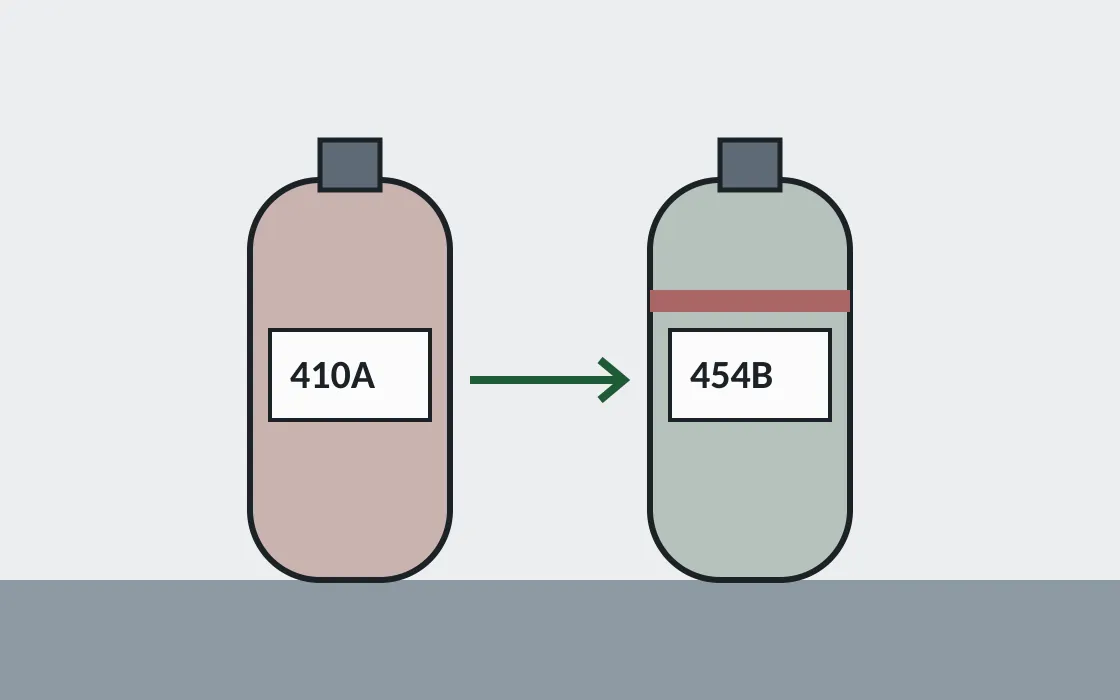
Most new central air conditioners and heat pumps sold in California now use R-454B or R-32 instead of R-410A.
That’s because California and federal rules limit how much a refrigerant can warm the climate, measured as global warming potential (GWP). The California Air Resources Board says new air conditioning equipment must use refrigerants with a GWP below 750. Ducted central AC, heat pumps, mini-splits and packaged rooftop units reached that limit on January 1, 2025. R-410A’s GWP is far above 750.
So when you ask for estimates in 2026, many will quote equipment on a newer refrigerant. Some may still quote R-410A units built before 2025. This guide explains both.
Last updated November 2026.
Can a contractor still install an R-410A system in 2026?
Yes, if the equipment was made before January 1, 2025, but that stock is limited and shrinking.
Two sets of rules apply in Stockton:
- California: CARB’s HFC regulation ties its prohibitions to the equipment’s date of manufacture, which it defines by the date on the manufacturer’s equipment label. New “other air-conditioning” equipment using refrigerants with a GWP of 750 or more is prohibited as of January 1, 2025.
- Federal: the EPA’s final rule published May 26, 2026 lets residential and light commercial AC and heat pump equipment made in or imported into the U.S. before January 1, 2025 continue to be installed. Installing new R-410A systems made or imported after that date is still prohibited. ACHR News reported that the rule removed the old January 1, 2026 installation deadline.
If you’re quoted R-410A equipment, ask for the manufacture date on the unit’s label. Then weigh it against the trade-offs below.
What are the trade-offs of R-410A versus a newer refrigerant?
It comes down to warranty, matching parts and future service, so ask every contractor the same questions.
Ask each contractor these questions about any R-410A quote:
- When was each piece made, and does it have the full manufacturer warranty?
- Is the outdoor unit matched to a new indoor coil, or to my old one?
- Do you expect service refrigerant prices to change over the life of the system?
And for a quote on R-454B or R-32 equipment:
- Will the line set be replaced or flushed, and is that in the price?
- Does the indoor coil or air handler need to change too?
- Are any safety controls, such as leak sensors, part of the system, and are they included?
Can I replace only the outdoor unit?
Sometimes, but mixing old and new parts limits your choices, so ask before you agree to it.
Air conditioners and heat pumps are rated as matched indoor and outdoor sets. A new outdoor unit on a newer refrigerant usually needs a matching indoor coil, because the two refrigerants aren’t interchangeable. If only the outdoor unit failed and the indoor coil is fairly new, ask the contractor to explain which option keeps the full warranty and the rated efficiency.
Ask the contractor to confirm in writing that the outdoor unit being installed meets CARB’s refrigerant rules for its date of manufacture.
What efficiency does a new unit need in California?
Split air conditioners under 45,000 Btu per hour need at least 14.3 SEER2 and 11.7 EER2 in California.
The U.S. Department of Energy’s 2023 standards FAQ explains that California is in the Southwest region, which has stricter rules for split and packaged air conditioners than the North. Split units of 45,000 Btu per hour and up need 13.8 SEER2 and 11.2 EER2. Split heat pumps nationwide need 14.3 SEER2 and 7.5 HSPF2. The DOE says it’s illegal for a contractor to install an air conditioner that doesn’t meet the regional standard.
The EER2 rating matters in Stockton because it measures performance at high outdoor temperatures. NOAA puts the area’s 1% cooling design temperature at 98°F, per its engineering weather data for Stockton Metro Airport.
What about gas furnaces?
Furnaces don’t use refrigerant, but new gas furnaces in the valley must meet a low-NOx limit.
Valley Air District Rule 4905 limits nitrogen oxide emissions from natural gas fan-type central furnaces to 14 nanograms per joule. According to the district’s February 2026 staff report, it covers anyone who sells or installs them. That includes gas-electric package units under 65,000 Btu per hour of cooling. See furnace replacement for more.
Are there tax credits or rebates for the new equipment?
Not the federal credit; it covered only equipment placed in service by the end of 2025.
The IRS limits the Energy Efficient Home Improvement Credit to qualifying property placed in service before the end of 2025. California’s main heat pump programs are also tapped out for now. TECH Clean California reports that single-family HEEHRA rebates were fully reserved statewide as of February 24, 2026. If a contractor mentions a rebate, ask which program it is and whether money has been reserved for your job.
Which dates matter?
Five dates explain most of what you’ll hear from contractors in 2026.
| Date | What changed | Source |
|---|---|---|
| January 1, 2023 | New regional efficiency standards for central air conditioners in the Southwest, including California | DOE |
| December 2023 | EPA allowed pre-2025 R-410A equipment to be installed until January 1, 2026 | EPA |
| January 1, 2025 | California’s under-750 GWP limit took effect for central AC, heat pumps, mini-splits and packaged units | CARB |
| January 1, 2026 | California’s 2025 Energy Code took effect for new permit applications | CEC |
| May 26, 2026 | EPA final rule let pre-2025 equipment keep being installed, with no end date | Federal Register |
How can I check what I’m being quoted?
Ask for the model numbers of every piece, then check the label and the rating certificate.
The outdoor unit’s nameplate lists the refrigerant type and, under California’s rules, a date of manufacture. The matched indoor and outdoor model numbers together carry the SEER2, EER2 and HSPF2 ratings that the DOE standards use. A good estimate lists those model numbers so you can compare two quotes line by line, rather than comparing brand names or tonnage alone.
What if my current system still works?
Then there’s no rule forcing you to replace it; you can keep repairing it.
The refrigerant rules cover new equipment, not systems already in your home. If your R-410A system runs well, a repair may be the better value, especially when the fault is a small part. Several Stockton reviewers said they were pushed toward a new unit when a capacitor was the real problem, so ask the technician to name the failed part.
It still pays to plan ahead. Find the age on the outdoor unit’s label, note how often it has needed service, and get a replacement estimate before the hottest weeks so you aren’t choosing in a hurry. When the time comes, ask for a quote on newer-refrigerant equipment and, if offered, a quote on pre-2025 stock, so you can compare price, warranty and parts side by side.
Plan your replacement
The main page for this topic is central AC replacement. Considering one electric system instead? Read heat pump replacement. For permits and the duct test, see the Stockton permit guide. Prices are in the cost guide.
Time to price a new system?
Call and we’ll connect you with a local HVAC contractor for a free replacement estimate.
Call for a free quote (209) 420-1354Prefer not to call? Send a quick request
Stockton HVAC Expert is a free referral service, not an HVAC contractor. Calls connect you with an independent local business that may pay us. Calls are recorded. Disclosure